
Review · ROME
From Rome: Ostia Antica Guided Half-Day Trip by Train
Ostia Antica gives you something Rome itself often cannot: room to picture ordinary Roman life. You walk along the Decumanus Maximus, pass taverns and warehouses, study the Baths of Neptune mosaic, and sit in an amphitheater where thousands once watched spectacles. It feels less like a collection of grand monuments and more like an abandoned city.
I like the short train ride from Rome and the small group of no more than 12 people. I also like the guides’ lively approach. Rob, Cat, Alberto, Laura, and Caterina are among the guides praised for clear explanations, humor, good pacing, and vivid stories.
The main drawback is the amount of walking on exposed archaeological ground. The site is not suitable for wheelchair users, strollers are not allowed, and hot weather can make the three-hour visit tiring. You also return to Rome without the guide unless you choose to stay in Ostia.
Key points at a glance
- A real Roman port city: See streets, apartments, shops, warehouses, baths, theaters, and public toilets rather than only grand temples.
- Easy transport from Rome: Meet at Cafe Piramide near the Piramide Metro stop, then take a short train journey with your guide.
- Small-group attention: Groups are limited to 12, making it easier to hear explanations and ask questions.
- Top sights included: The Decumanus Maximus, Baths of Neptune, amphitheater, and communal Forica all feature in the guided walk.
- Flexible finish: Return to Rome, stay in Ostia Antica, explore the modern town, visit the museum, or continue toward the beach.
- Good value at $58: The price includes return train travel, site admission, and a three-hour guided visit.
Why Ostia Antica is worth your half-day

Rome’s famous ruins often focus on emperors, generals, and public spectacle. Ostia Antica shows you the working city that helped Rome function. This was the ancient harbor town where goods moved through the port, merchants conducted business, and residents lived in apartments, visited baths, ate at taverns, and used public facilities.
That everyday focus is the site’s great strength. You are not simply looking at a single monument. You are moving through a complete urban setting, with long streets and walls that still suggest the size of the original buildings.
Ostia was founded in the 4th century BC and eventually became a major harbor town. At its height, it was home to more than 100,000 people. The ruins are spread across a large archaeological area, so a guide adds real value. Without one, you can see the stones but miss much of the meaning.
The guides are especially good at turning fragments into scenes. Rob is known for acting out parts of the ancient world and using humor to make the information stick. Cat is praised for keeping the group moving while still stopping at the key places. Alberto is often noted for his clear explanations and friendly manner. The exact guide depends on the date, but the experience works best when you listen closely and ask questions.
More Train Day Trips in Italy
- Ancient Ostia Antica Semi-Private Day Trip from Rome by Train with Guide
★ 4.5 · 579 reviews - Venice Day Trip from Rome by High-Speed Train with Happy Hour
★ 4.5 · 445 reviews - From Rome: Day Trip to Venice by High-Speed Train
★ 4.6 · 352 reviews
Meeting at Cafe Piramide
The meeting point is Cafe Piramide, at Piazzale Ostiense 9. When you face the Piramide Metro station on Line B, the cafe is on your right. Look for the white umbrellas outside, the nearby train tracks, and the City Wonders sign.
Give yourself enough time to find the cafe. The area around Piramide includes Metro and train connections, and one account of the meeting point suggests that white umbrellas across the street can cause confusion. Follow the directions carefully rather than assuming the first cafe you see is the right one.
The guide provides the train tickets and gathers the group before departure. This is useful in Rome, where stations can feel busy and confusing, especially early in the day. The guide also keeps track of the group during the journey.
The 15-minute train ride to the ruins
The outward train journey takes about 15 minutes. That is one of the best features of this excursion. You do not lose half a day to a long transfer, and you do not need to arrange a taxi or navigate the entire route alone.
The train ride also changes the rhythm of your Rome visit. After crowded streets and busy monuments, you are soon heading toward a large archaeological park with more open space. The guide accompanies you on the way to Ostia Antica and explains what to expect.
Once you arrive, the archaeological site is less than a five-minute walk from the station. Your guide leads the group through the entrance, so you can concentrate on the visit rather than ticket details.
Walking the Decumanus Maximus
The main street, the Decumanus Maximus, is the natural starting point for understanding Ostia. This broad thoroughfare cuts through the ancient town and helps you grasp its scale. Walking here is more revealing than viewing isolated ruins because you can see how homes, shops, public buildings, and business premises related to one another.
Roman statues line parts of the walkways, while walls and paved streets give you a strong sense of the original town plan. Several people who have visited Pompeii find Ostia just as interesting, and some prefer it because it is generally much quieter.
The comparison with Pompeii is useful, but do not expect the same kind of site. Pompeii is famous for its sudden destruction and preserved domestic interiors. Ostia is especially valuable for showing a port city at work. You see the infrastructure of trade and daily life, not only the remains of an unusual disaster.
The guide selects the most important areas rather than trying to explain every stone. That matters because the site is large. A well-paced tour can cover the main sights without making you feel hurried, but you will not see every corner during the three-hour guided portion.
Same base, another direction out:
- From Rome: Pompeii, Amalfi Coast, and Sorrento Day Trip
★ 4.6 · 7,031 reviews - From Rome: Pompeii, Amalfi Coast and Positano Day Trip
★ 4.6 · 6,620 reviews - Pompeii, Amalfi Coast and Positano Day Trip from Rome
★ 4.5 · 6,250 reviews - Pompeii and Mount Vesuvius Day Trip from Rome with Pizza Lunch
★ 4.5 · 6,151 reviews
The Baths of Neptune and its sea-god mosaic
The Baths of Neptune are one of the visual highlights. Their large mosaic shows the sea god being pulled by a four-horse chariot. The artwork remains striking because it connects the building to the port city’s maritime identity.
Your guide can help you read the scene and understand why baths mattered beyond washing. Roman baths were social places, part of the ordinary routine of city life. At Ostia, they also help show the resources and public services available in a major Roman town.
The site is not protected by shade at every point, so the weather matters. On hot days, guides such as Alberto have been praised for finding shaded places for explanations. Still, bring water and wear shoes with firm soles. The ground is uneven, and you will be on your feet for much of the visit.
The amphitheater and the communal Forica
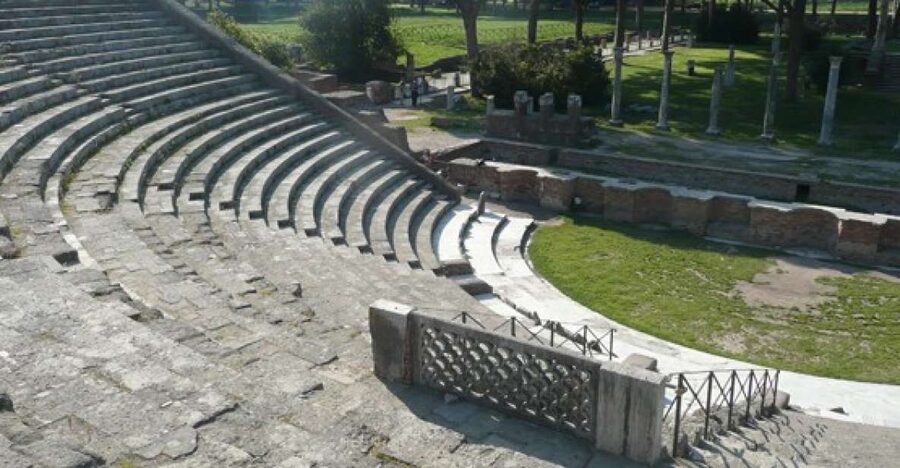
The amphitheater gives you a chance to see Ostia as a place of public entertainment. It was first built in 12 BC and could hold about 3,500 spectators. Sitting in the stands helps you picture the noise and movement of a Roman crowd, even though the building is now quiet.
This is a good stop for families and anyone who learns through physical settings. You can see where the audience sat and how the building fitted into the town. The guide’s explanation adds the social context that the stonework alone cannot provide.
The communal Forica offers a different kind of lesson. A marble bench has 20 evenly spaced holes along four walls of a large open room. It is a very direct reminder that Roman life included public facilities that were practical, social, and not especially private.
The Forica often gets a laugh, but it also makes the ancient city feel human. Grand monuments can make Rome seem remote. A public washroom brings the past down to earth. You may even be invited to sit briefly and experience one of the more ordinary features of the site.
Taverns, warehouses, theaters, and ordinary homes
Ostia’s appeal comes from its variety. You pass remains of taverns, thermal baths, warehouses, theaters, and residential buildings. Each type of structure answers a different question: where did people eat, where were goods stored, how did residents spend free time, and how did a busy port support its population?
The surviving walls are especially useful because they show that some buildings rose above ground level. You can get a better impression of ancient urban density than you often can in Rome’s central ruins. Frescoes, mosaics, statues, and architectural details appear along the route, though their condition and access can vary.
This is where a good guide earns the fee. A guide can point out what belonged to a shop, explain how the port supported Rome, and connect a mosaic to the building around it. Guides praised for using photographs, stories, and occasional reenactment make the ruins easier to picture without turning the tour into a dry lecture.
A three-hour walk with room to pause
The guided visit lasts about three hours. That is enough time to cover the main sights and still stop for questions, but it is not a quick photo stop. You need comfortable shoes, sun protection, and water.
The pace is generally steady rather than frantic. Some guides include short breaks of around 15 minutes, giving you a chance to look around independently or stop for a snack and drink at the snack bar. The exact rhythm depends on the group and guide, but the small size helps.
A group limit of 12 is a practical advantage. You can hear the guide more easily, ask questions without holding up a large crowd, and stay close while crossing the broad site. Several guides are also praised for watching the group carefully, which matters in a spread-out archaeological park.
The site can feel hot in summer and exposed in bright weather. Spring, autumn, and cooler winter days may be more comfortable for walking. In winter, check the museum hours if you plan to visit it afterward. One early-year visit found the museum closing around 1:30 PM, so timing can matter.
Staying in Ostia after the tour
The tour service finishes back at Piramide Metro Station at approximately 1:00 PM if you return with the group. But you do not have to leave Ostia immediately. You may remain at the archaeological park, explore the modern town, or continue toward the beach.
This flexibility makes the tour more useful than a simple escorted excursion. If you are interested in archaeology, stay longer and see parts of the site that were not included in the guided route. The museum is an especially sensible extra stop when it is open.
If you want a change of pace, the beach is an easy addition. Bring a towel, beachwear, and sports shoes if you plan to continue there. The tour information specifically recommends those items, so this is not merely a theoretical option.
The return journey is unescorted. Your train tickets are provided, and the guide explains how to get back, but you are responsible for returning if you stay behind. That is easy enough for confident independent visitors, but families or anyone who prefers a fully managed outing may want to return with the guide.
What the $58 price covers
At $58 per person, this is a solid value for a Rome day trip. The price includes the return train ticket, admission to Ostia Antica, and a three-hour English-language guided visit. You are paying for access and transport, but the guide is the main reason to choose this option instead of visiting alone.
The site is too large for a quick self-guided wander. You could explore independently, but you would need to organize the train, buy entry, find your way through the ruins, and decide which buildings deserve your time. The tour removes that work and gives you a clear route through the major sights.
Food and drinks are not included, and neither is hotel pickup or drop-off. You meet at Piramide, so you need to reach the starting point yourself. If public transport is affected by a strike or another unexpected problem, a minibus is provided at no additional cost.
Free cancellation up to 24 hours before departure and the option to reserve now and pay later make the booking less rigid. Starting times vary, so check the schedule for your date.
Who should book this Ostia Antica tour
I would choose this trip if you have already seen Rome’s major central monuments and want a different view of the ancient city. It is also a smart choice if Pompeii is not practical from Rome but you still want a substantial Roman archaeological site.
History fans will get the most from it, but you do not need specialist knowledge. The amphitheater, mosaic, public washrooms, and long streets give you plenty to see even if you are new to archaeology. Families may enjoy the practical details and lively storytelling, though younger children need to manage a long outdoor walk.
You should think twice if you need step-free access, dislike uneven ground, or have limited stamina. Wheelchair users cannot take this tour, and baby strollers are not allowed. The combination of train travel and three hours on foot also makes it less suitable for anyone seeking a short, low-effort outing.
Should you book it?
Book this tour if you want Roman history at street level, with the context that turns walls, mosaics, and public buildings into a functioning town. The short train journey, small group, included admission, and skilled English-speaking guides make $58 a fair price.
Choose it with the plan to stay afterward if you want the museum, more ruins, or the beach. If you only want a quick look at a famous monument, Rome offers easier options. But if you have half a day and want to see how ordinary Romans lived, Ostia Antica is one of the strongest choices near the city.
FAQ
Where does the Ostia Antica tour meet?
Meet at Cafe Piramide at Piazzale Ostiense 9. When facing the Piramide Metro stop on Line B, the cafe is on your right, near the train tracks. Look for the white umbrellas and the City Wonders sign.
How long is the tour?
The full experience lasts about four hours. The train ride to Ostia takes about 15 minutes, the guided visit lasts about three hours, and the return train takes about 20 minutes.
Is the train ticket included?
Yes. The price includes the return train ticket between Rome and Ostia Antica.
Is entry to Ostia Antica included?
Yes. Admission to the Ostia Antica archaeological site is included.
Is the tour offered in English?
Yes. The live guide conducts the tour in English.
How many people are in the group?
The group is limited to 12 participants.
Can I stay in Ostia after the guided visit?
Yes. You may remain at Ostia Antica, explore the modern town, or go to a nearby beach. If you stay, your return journey to Rome is unescorted.
Is the tour suitable for wheelchair users or strollers?
No. The tour is not suitable for wheelchair users, and baby strollers are not allowed.
More half days out around Rome
- Athens: Cape Sounion & Poseidon Temple Sunset Half-Day Trip
★ 4.8 · 8,241 reviews - From Nice: Eze, Monaco, & Monte-Carlo Half-Day Trip
★ 4.5 · 5,642 reviews - From Paris: Giverny, Monet’s Home & Gardens Half-Day Trip
★ 4.5 · 2,887 reviews - Half-Day Trip to Montmorency Falls and Ste-Anne-de-Beaupré from Quebec city
★ 4.0 · 2,718 reviews
More Train Day Trips in Rome
- From Milan: Bernina Train and St. Moritz Day Trip
★ 4.5 · 4,495 reviews - Salzburg Sightseeing Day Trip from Munich by Rail
★ 4.5 · 3,125 reviews - Bangkok: Damnoen Saduak, Train Market & Mahanakhon Day Trip
★ 4.7 · 2,162 reviews - From Munich: Salzburg Day Trip by Train
★ 4.7 · 1,547 reviews
New day trips around Rome
- Assisi & Orvieto Day Trip from Rome★ 4.5 · 341 reviews
- Venice Day Trip from Rome by High-Speed Train with Happy Hour★ 4.5 · 445 reviews
- From Rome: Day Trip to Venice by High-Speed Train★ 4.6 · 352 reviews
- Private Day Trip Rome to Pompeii & Amalfi Coast tickets included★ 5.0 · 61 reviews
- Private Tour: Pompeii and Positano Day Trip from Rome★ 4.5 · 74 reviews
- Private Tour: Day Trip to Florence and Pisa from Rome with Lunch★ 4.0 · 65 reviews
- Ancient Ostia Antica Semi-Private Day Trip from Rome by Train with Guide★ 4.5 · 579 reviews
- Tivoli Full Day Trip from Rome: Hadrian’s Villa and Villa D’Este★ 4.5 · 1,730 reviews
Day Trips from Rome, compared.
From Rome: Pompeii, Amalfi Coast, and Sorrento Day Trip
Read our review →
Pompeii and Mount Vesuvius Day Trip from Rome with Pizza Lunch
Read our review →
Rome: Tuscany & Montepulciano Day Trip with Lunch & Wine Tasting
Read our review →
From Rome: Pompeii Day Trip with Optional Vesuvius and Lunch
Read our review →
Rome: Amalfi Coast & Positano Day Trip with Coastal Cruise
Read our review →
Rome: Tuscany & Montepulciano Day Trip with Lunch & Wines
Read our review →
Tivoli Full Day Trip from Rome: Hadrian’s Villa and Villa D’Este
Read our review →
Ancient Ostia Antica Semi-Private Day Trip from Rome by Train with Guide
Read our review →This day trip also appears in