Review · TBILISI
Day Trip to Mtskheta Gori and Uplistsikhe
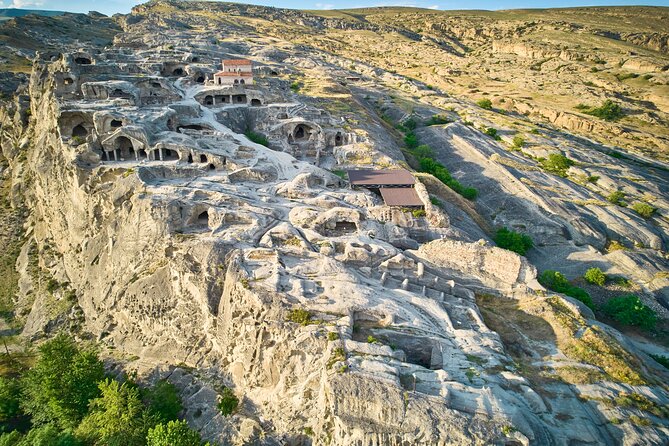
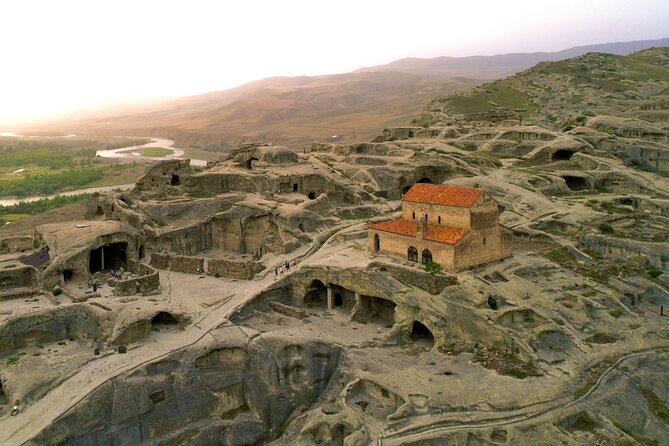
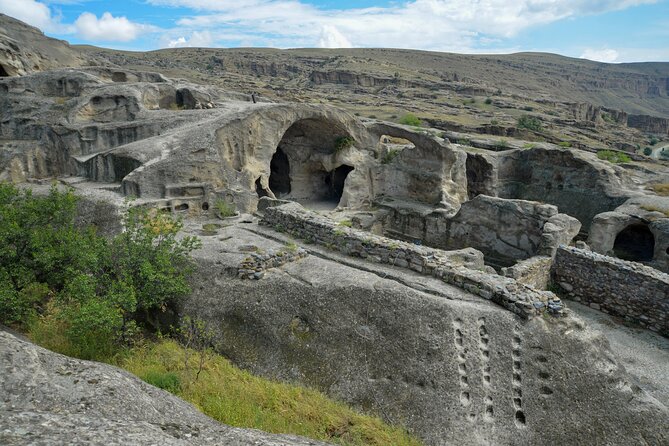
Uplistsikhe is the star here: an ancient town cut into a rocky hillside above the Mtkvari River, with caves, chambers, steps, and wide views that make Georgia’s early past feel surprisingly close. The day then shifts from pagan and Christian sites to Soviet history in Gori, before ending among the churches of Mtskheta.
I like the wide historical range, from an Iron Age cave settlement to Stalin’s birthplace and Georgia’s early Christian capital. I also like the flexibility: you can choose the optional lunch, spend free time in Gori, or visit the Stalin Museum.
The catch is that this is a long, active day. Uplistsikhe has uneven ground and many steps, and the schedule can include waiting or extra driving around Gori. Bring water, wear sensible shoes, and expect a full outing rather than a relaxed countryside jaunt.
Key points to know before booking
- Uplistsikhe comes first: This rock-cut town is the most unusual stop, with ancient chambers, religious spaces, and fine views over the Mtkvari River.
- The tour covers three very different eras: Ancient Georgia at Uplistsikhe, Soviet history in Gori, and early Christian Georgia at Jvari and Mtskheta.
- Guides make a real difference: Guides such as Nini, Dimitri, Tota, Tako, Nene, and Metroman are noted for clear English, humor, legends, and strong historical context.
- Lunch is optional: The Georgian meal costs 45 GEL, about $17, while free time in Gori lets you make your own plans.
- Extra fees add up: Uplistsikhe costs 15 GEL and the Stalin Museum costs 15 GEL, both about $6 each.
- Plan for walking and weather: The tour runs in all weather, and church visits require modest clothing and head covering for women.
Why this day trip works so well from Tbilisi
Tbilisi is an excellent base, but some of Georgia’s most interesting historic sites sit beyond easy city transport. This tour links them in one long loop, saving you the trouble of arranging a car, driver, and separate explanations at each stop.
The advertised schedule runs about 10 hours, beginning at 9:00 am near Avlabari Metro Station and returning around 7:00 to 7:30 pm. The order generally sends you to the farthest points first and works back toward Tbilisi, which is a sensible way to use the day.
You travel with a guide and driver rather than simply being dropped at the sights. That matters most at Uplistsikhe and the Stalin Museum, where the setting becomes much clearer when someone explains how the site developed and how it fits into Georgian history.
The group can be large, with a stated maximum of 100 people, though the vehicle may be a smaller minibus. One account describes a 16-passenger Mercedes coach carrying 12 people. Vehicle size depends on the departure, so you should expect group-tour conditions rather than a private excursion.
More day trips around the world:
- Tuscany Day Trip from Florence: Siena, San Gimignano, Pisa and Lunch at a Winery
★ 5.0 · 21,634 reviews - From Amsterdam: Zaanse Schans, Volendam & Marken Day Trip
★ 4.4 · 18,501 reviews - From Munich: Neuschwanstein & Linderhof Castle Full-Day Trip
★ 4.6 · 14,646 reviews
Uplistsikhe: Georgia’s ancient town in the rock
The first major stop is Uplistsikhe, reached at about 11:00 am. The name is often translated as Lord’s Fortress, and the site grew over centuries from the Early Iron Age through the late medieval period.
What you see is not one single cave or ruin. It is a spread-out settlement cut into sandstone, with rooms, passages, terraces, ritual areas, and architectural traces from different periods. Pagan and Christian elements share the same hill, showing how older traditions and newer faiths existed side by side.
The setting does much of the work. Uplistsikhe sits above the Mtkvari River, and the open views help you understand why people chose this hard-to-reach place. It was a settlement, a religious center, and a strategic point, not just a collection of photogenic hollows.
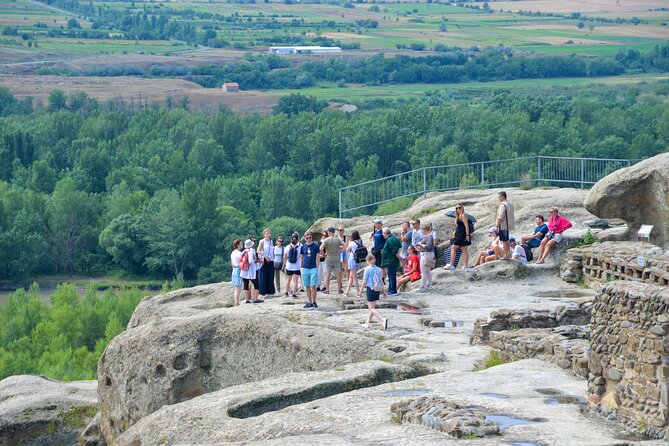
Give yourself time to look at the stone under your feet. The paths are uneven, and there are steps and inclines. A hat and sturdy shoes are useful, especially in sunny weather. You should also bring your own bottled water. A cafe and restrooms are available near the entrance and exit, but water is not included with the tour.
The entrance fee is separate, at 15 GEL, about $6. That is a small extra cost for the most distinctive site of the day. If you have seen the cave settlements of Cappadocia, Uplistsikhe will still feel different. Its mix of open rock-cut streets, ancient rooms, river views, and Christian structures gives it a character of its own.
Gori gives you a choice at lunchtime
The tour reaches Gori around 1:00 pm. This is the practical midpoint of the day, and it is where you choose between an organized Georgian meal and free time.
The optional lunch costs 45 GEL, approximately $17 per person. It is presented as a local meal, and the group dining option can be a pleasant way to try Georgian food without having to search for a restaurant during a tight schedule.
There is a practical wrinkle. The lunch restaurant is not necessarily in the city center, so the group may drive there and back. That can make the stop feel less efficient if you would rather explore Gori. Food service has also not always been perfectly timed, so anyone particular about meals may prefer free time.
If you skip lunch, you can use the break to walk around Gori, find your own food, or visit the fortress. Gori Fortress sits above the city and offers broad views over the surrounding area. It is a good alternative if you want fresh air and a little movement after the ride to Uplistsikhe.
The free-time option also suits people who do not want a heavy meal before the afternoon’s churches. On a day this long, a quick bite can be more sensible than a large lunch.
The Stalin Museum adds a complicated modern chapter
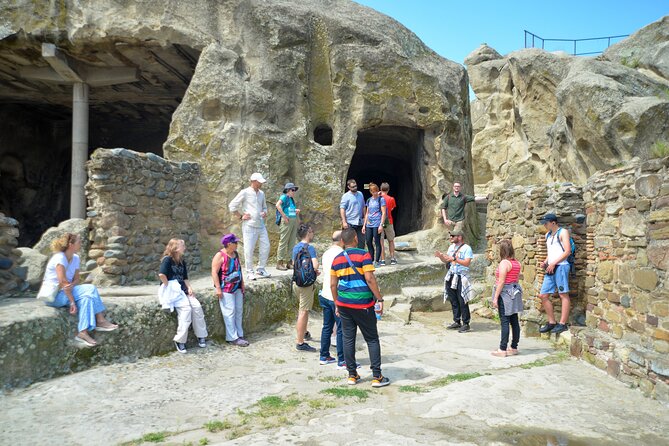
At about 2:45 pm, the group reaches the Stalin Museum. Joseph Stalin was born in Gori, and the museum is devoted to his life and political career.
This is not a neutral, modern museum in the usual sense. It retains a strong Soviet-era character, which makes the visit interesting in two ways. You learn about Stalin, but you also see how the Soviet period presented Stalin to the public.
The museum includes Stalin’s original house and his railway carriage. The carriage is an especially memorable object because it shows the practical, guarded way he traveled. Inside the museum, the guide’s explanation is valuable. Names such as Nini, Dimitri, Tota, and Nene have been praised for making the material easier to understand and for adding context beyond the displays.
The entrance fee is not included and costs 15 GEL, roughly $6. If you have any interest in twentieth-century politics, Soviet culture, or the way national memory is shaped, I think it is worth paying for. If the subject does not appeal to you, free time in Gori gives you a reasonable alternative.
Allow enough time for the museum choice before the day begins. You may not be able to do the full museum and a long city walk, especially if the group is keeping to schedule.
Same base, another direction out:
- Lisbon: Pena Palace, Sintra, Cabo da Roca, & Cascais Daytrip
★ 4.7 · 9,981 reviews - Florence: Pisa, Siena and San Gimignano Day Trip with Lunch
★ 4.6 · 9,771 reviews - From Marrakech: Day Trip to Ouarzazate and Ait Benhaddou
★ 4.7 · 9,447 reviews - From Naples: Sorrento, Positano & Amalfi Coast – Small Group Tour
★ 5.0 · 8,643 reviews
Jvari Monastery offers the great view
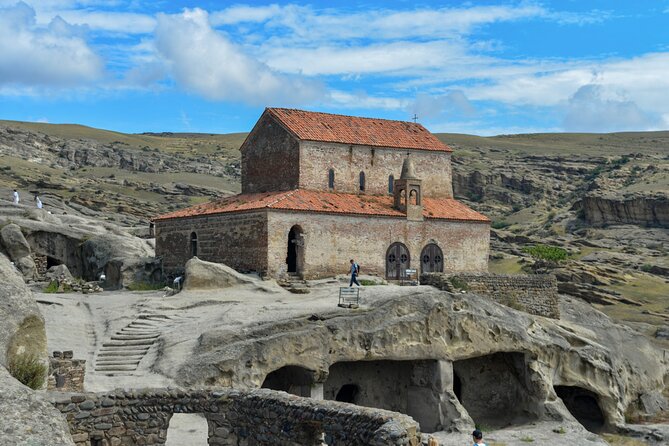
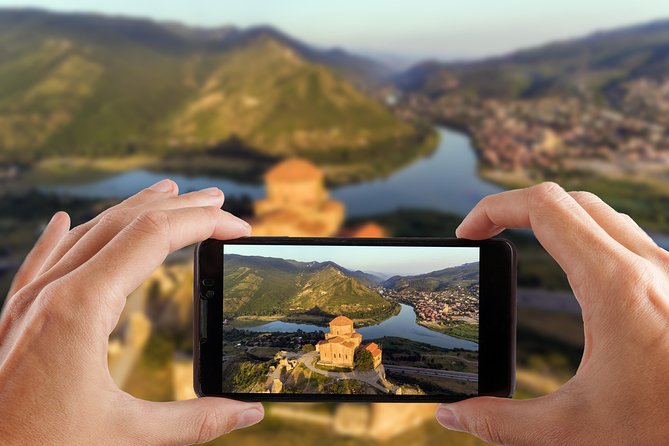
Jvari Monastery comes later in the afternoon, at about 4:35 pm. The name means Monastery of the Cross, and the sixth-century Georgian Orthodox complex sits on a rocky hill above the meeting point of the Mtkvari and Aragvi rivers.
This is a short stop, listed at about 30 minutes, but it is one of the most scenic. From the hilltop, you can look toward Mtskheta and see the two rivers coming together below. The position gives Jvari a strong sense of place, and it helps explain why this area became so important to Georgia.
The building is compact and restrained compared with grander cathedrals. Its importance comes from age, design, religious meaning, and location. Jvari is part of the UNESCO-listed historic monuments of Mtskheta, and it represents an important stage in the development of Georgian Christianity.
The site can be exposed to wind and changing weather. You should have a layer handy, even on a warm day in Tbilisi. The tour operates in all weather, so do not count on a sunny forecast as part of the experience.
Mtskheta and Svetitskhoveli Cathedral
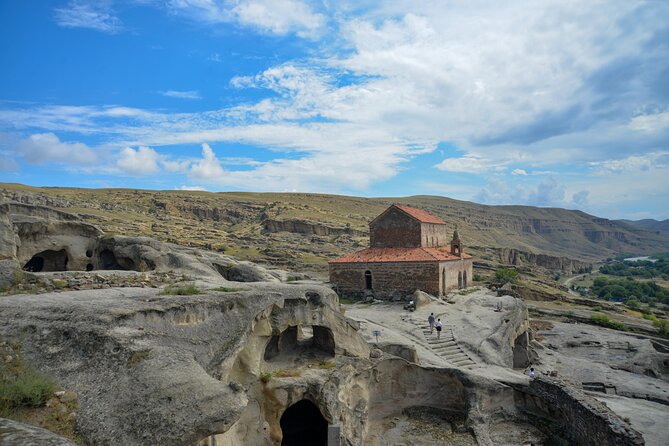
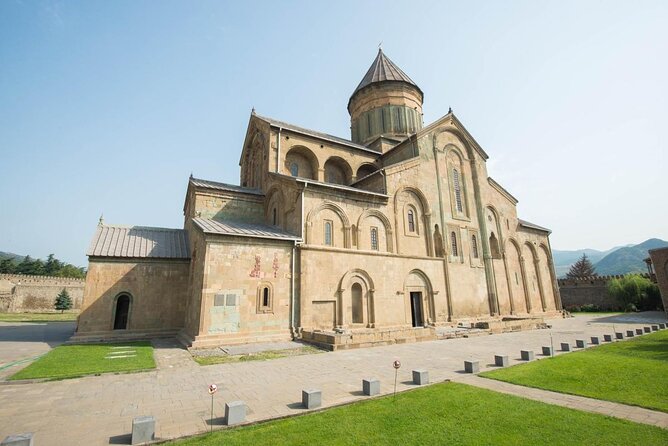
The final major stop is Svetitskhoveli Cathedral in Mtskheta, reached at about 5:25 pm. Mtskheta served as the capital of the early Georgian Kingdom of Iberia from the third century BC to the fifth century AD. It later remained an important place for royal coronations and burials.
Svetitskhoveli means Cathedral of the Living Pillar. It is now the second-largest church in Georgia, after Tbilisi’s Holy Trinity Cathedral, and is one of the country’s most revered Orthodox churches.
The cathedral is linked to the tradition that Christ’s robe is buried beneath it. You do not need to accept every religious tradition literally to appreciate what the site means to Georgian identity. This is a place of worship, royal memory, pilgrimage, and national history all at once.
The visit is usually the gentlest part of the day. You can look at the carved stonework, interior frescoes, tombs, and surrounding streets. The stop is listed at about an hour and a half, although the exact amount of free time can vary with traffic, crowds, and the group’s pace.
Some people wish there were more time to see Mtskheta beyond the cathedral. That is a fair point. The tour gives you the main sights, but it is not a slow, unstructured exploration of the old town. Think of it as a carefully chosen introduction.
You must dress respectfully for the churches. Shorts are not permitted, and women need to cover their heads. Carrying a scarf is the easiest solution.
The guide is a major part of the value
The route is strong, but the guide determines how much you take from it. This is not a tour where you should expect a long lecture at every site followed by constant hand-holding. It works best when you want clear explanations, useful stories, and enough independent time to look around.
Guides named Nini, Nina, Dimitri, Deme, Tota, Tako, Toka, Nene, Paata, Metroman, and Niko have all been associated with highly rated departures. The repeated strengths are fluent English, humor, calm organization, and an ability to connect legends with documented events.
That variety also means you should not book because you expect one particular guide unless the operator confirms it. What you can reasonably expect is a guide assigned to the departure, not a fixed personality or presentation style.
Some departures are more guided than others. At Uplistsikhe, Jvari, and Svetitskhoveli, you will have time to walk and look for yourself. That is a plus if you dislike being kept in a tight group, but a drawback if you want a private guide beside you every minute.
Is $29 a good price?
At $29 per person, the basic price is strong for a full day outside Tbilisi. Round-trip transport and professional guiding are included, and the route covers sites that are awkward to combine without a car.
The low price needs to be read correctly. It does not include the Uplistsikhe entrance fee, the Stalin Museum, or lunch. If you choose all three extras, add roughly $29 more using the listed exchange rates, bringing the day to about $58 per person before any other personal spending.
That is still reasonable for the distance covered and the range of sights, but it is not an all-inclusive $29 outing. If you want the full historical program, budget for the two admissions. If you prefer flexibility, pay only for Uplistsikhe and decide about the museum once you understand your mood and the day’s timing.
Free cancellation is available if you cancel at least 24 hours before the start time. Changes or cancellations made later are not accepted for a refund.
What to pack for the 10-hour route
Keep your day bag light, but bring the practical basics:
- Water, because it is not provided
- Comfortable shoes with a firm sole
- A hat and sun protection for Uplistsikhe
- A scarf for church visits
- Layers for the exposed hilltop at Jvari
- Some Georgian lari for entrance fees and food
The tour runs in all weather. Since you will spend time outdoors at Uplistsikhe, Jvari, and around Gori, weather can change the feel of the day even when the itinerary remains the same.
The route includes walking, stairs, and uneven rock. Most people aged five and older can participate, but anyone with mobility concerns should think carefully about Uplistsikhe before booking.
Who should book this tour?
I would choose this trip if you have limited time in Tbilisi and want a broad introduction to Georgian history in one day. It suits people who enjoy ancient ruins, churches, Soviet history, scenic viewpoints, and a guide who can connect the pieces.
It is also a good match for solo visitors and couples who do not want to rent a car. The group setting can make it easy to meet people, particularly around the optional lunch or free time in Gori.
I would not choose it if you want slow photography stops, a private schedule, or a deep visit to each location. You will cover a lot, but you will not linger everywhere. The long day, walking, and possible downtime in Gori are the trade-offs for seeing so much at a modest price.
Should you book the Mtskheta, Gori, and Uplistsikhe day trip?
Yes, if you want the best mix of major sights near Tbilisi and you are comfortable with a full, structured day. Uplistsikhe is the essential reason to go, while the Stalin Museum gives the outing an unusual modern counterpoint. Jvari and Svetitskhoveli then bring the focus back to Georgia’s early Christian story.
Book it with realistic expectations: pay extra for admissions, bring water, dress for churches, and leave room for timing changes. If that sounds fine, this is one of the better-value ways to see the historic heartland beyond Tbilisi without arranging your own transport.
FAQ
How long does the tour last?
The tour lasts approximately 10 hours. It begins at 9:00 am near Avlabari Metro Station and usually returns to the same meeting point around 7:00 to 7:30 pm.
What is included in the price?
Professional guide service and transportation are included. Lunch, the Uplistsikhe entrance fee, and the Stalin Museum entrance fee are not included.
How much do the optional extras cost?
The optional lunch costs 45 GEL, about $17. Uplistsikhe costs 15 GEL, about $6, and the Stalin Museum costs 15 GEL, also about $6.
Can I skip the optional lunch?
Yes. You can choose free time in Gori instead of the organized lunch. This may allow time to explore the city or visit Gori Fortress.
Is the Stalin Museum included?
No. The museum entrance costs 15 GEL, about $6, and is paid separately. Free time in Gori may be available if you choose not to enter.
What should I wear for the churches?
Shorts are not allowed inside the churches, and women need to cover their heads. Bring a scarf or other head covering, and dress respectfully.
Can children join the tour?
The minimum age is five. The tour operates in all weather, and most people who meet the age requirement can participate, though Uplistsikhe includes uneven ground and stairs.
New day trips around the world
- Beijing: Badaling Ancient Great Wall of China Day Trips★ 4.8 · 208 reviews
- Barcelona: Montserrat Monastery and Natural Park Day Trip★ 4.6 · 755 reviews
- Bari: Alberobello and Polignano a Mare Half-Day Trip★ 4.8 · 37 reviews
- Bari: Matera Day Trip★ 4.6 · 65 reviews
- Bangkok: Maeklong Railway & Amphawa Floating Market Day Trip★ 4.3 · 675 reviews
- Barcelona: Walking and Horse Riding Day-Trip in Montserrat★ 4.8 · 40 reviews
- Montserrat & Cava Wineries Day Trip from Barcelona w/ Pickup★ 4.6 · 218 reviews
- Bali: Ubud Waterfall, Village and Pool Club Day Trip★ 4.7 · 45 reviews
Day Trips from Tbilisi, compared.
Tbilisi: Day Trip to Kazbegi, Gudauri, Gergeti, and Ananuri
Read our review →
Day Trip to Kakheti Wine Region Including 9 Wine Tastings
Read our review →