
Review · PORTO
Best of Braga and Guimaraes Day Trip from Porto
Northern Portugal’s story begins in places like Braga and Guimarães, and this day trip gives you a quick, well-organized introduction to both. You’ll see Bom Jesus Sanctuary, one of Portugal’s most striking religious sites, then walk through Guimarães, the city tied to the birth of the nation.
I like the comfortable air-conditioned minibus and the good mix of guided visits, free time, and short walks. I also like that cathedral and castle admission are included, which makes the $71.35 price easier to justify. The main drawback is that the day can feel long, and tours may be given in English and Spanish together.
- Water-powered funicular: Ride or view Portugal’s first water-powered funicular, built in 1882.
- Braga’s cathedral: Visit the country’s first cathedral, begun before Portugal became an independent kingdom.
- Guimarães Castle: See the fortress linked by tradition to Afonso Henriques, Portugal’s first king.
- Free time for lunch: You have time in Braga or Guimarães to eat and explore at your own pace.
- Small-group transport: The air-conditioned minibus holds a maximum of 27 people.
- Porto bonus: Your booking includes access to a separate Living Tours walking tour in Porto.
Why Braga and Guimarães make a strong day trip
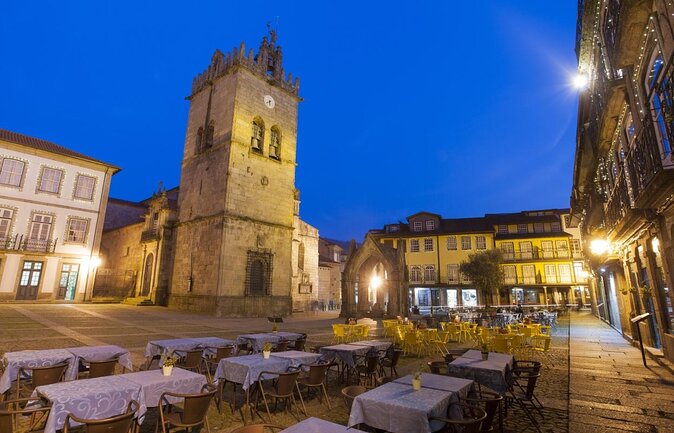
Porto is a fine base for exploring northern Portugal, but the city tells only part of the story. Braga brings religious tradition and grand stairways. Guimarães brings medieval streets, royal origins, and the early chapters of Portugal’s national story.
The two cities are close enough to visit in one day, yet different enough to avoid feeling repetitive. You spend the morning around Braga’s sanctuary and cathedral, then move to Guimarães for its castle, small Romanesque church, and old town.
The schedule runs about nine hours, beginning at 7:50 a.m. near São Bento Train Station and ending back at the same meeting point. That early start matters. You get a full day outside Porto and should return around late afternoon, leaving your evening free.
I see this as a good choice if you want historical context without arranging trains, buses, entrance tickets, and walking routes yourself. It is less suited to anyone who prefers a slow day in one town or dislikes fixed departure times.
Bom Jesus and the 300-meter funicular
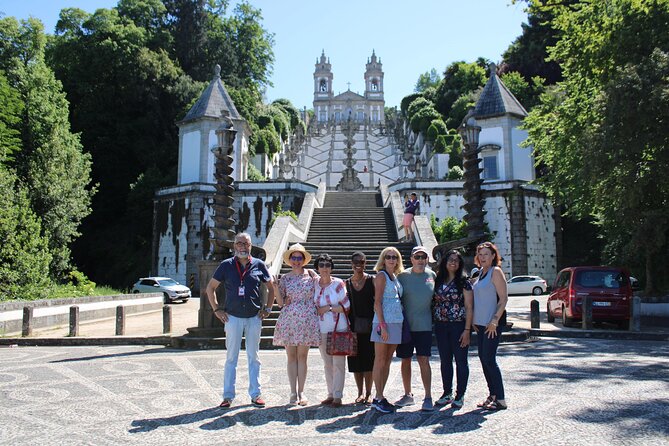
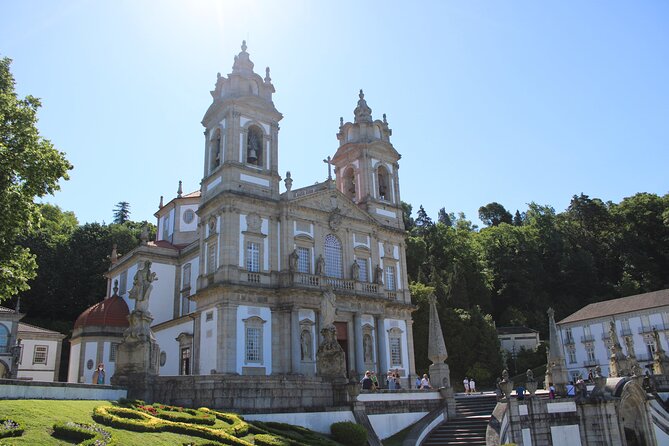
The first major stop is Bom Jesus do Monte, above Braga. The setting is memorable before you even reach the church: a long white staircase rises through wooded slopes, lined with fountains, statues, and small landings.
The staircase has 17 landings, each tied to a religious theme. You’ll see references to the Stations of the Cross, the five senses, the virtues, Moses receiving the commandments, and figures associated with Jesus’ condemnation.
The best view is from the bottom, where the stairway climbs in a carefully arranged pattern toward the church. Look up before following the group. The white church, granite stairway, and surrounding greenery form the scene that makes Bom Jesus worth the stop.
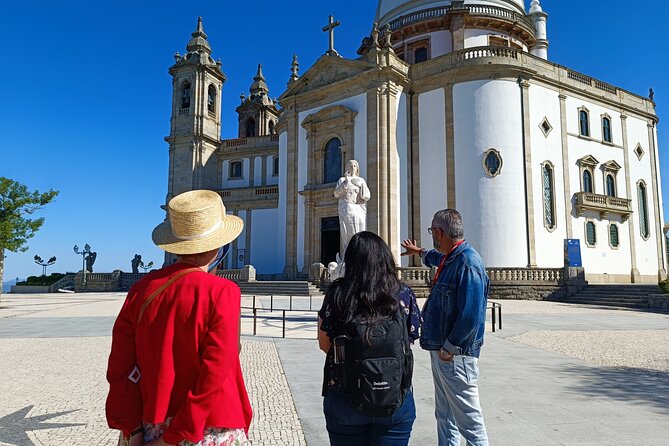
The sanctuary church was designed by Carlos Amarante in an Italian-influenced neoclassical style. It fits neatly into the hillside rather than sitting apart from it.
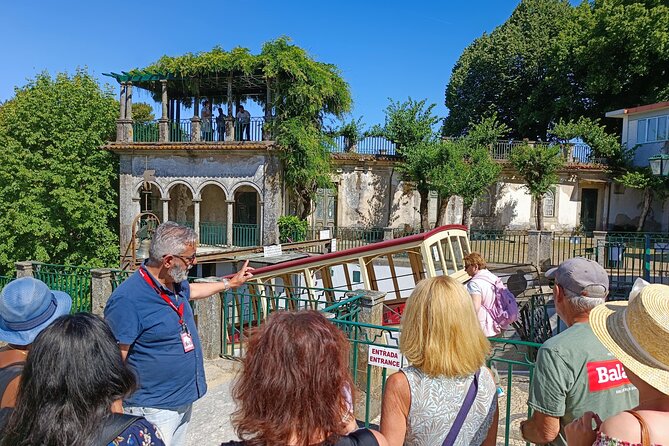
The funicular is the unusual engineering feature. Installed in 1882, it was the first of its kind in Portugal and still uses water power. The 300-meter ride takes about three minutes.
You have about 30 minutes here, so expect a focused visit rather than time to examine every fountain or climb every step. Entrance to the sanctuary is included. The stop works well for photographs and a short orientation, but people who want a long walk up the staircase may find the schedule too tight.
More day trips around Portugal:
- Lisbon: Pena Palace, Sintra, Cabo da Roca, & Cascais Daytrip
★ 4.7 · 9,981 reviews - Sintra and Cascais Small-Group Day Trip from Lisbon
★ 5.0 · 7,018 reviews - From Porto: Braga and Guimarães Full-Day Trip
★ 4.6 · 3,951 reviews
Braga Cathedral and an hour to wander
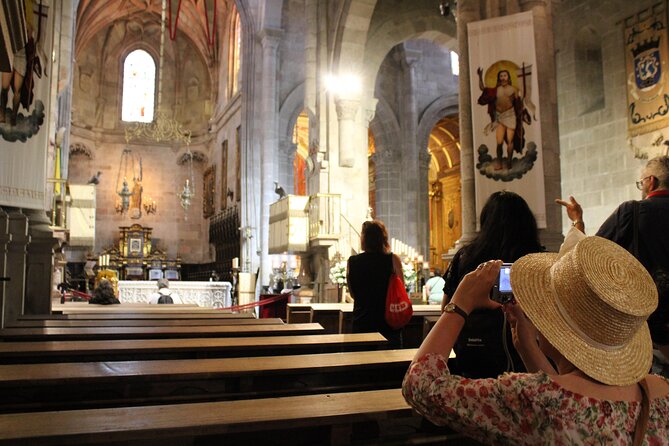
From Bom Jesus, the tour continues into Braga for the Sé de Braga, or Braga Cathedral. This is not simply another old church on a city walk. Construction began at the end of the 11th century, and the cathedral was consecrated in 1089, decades before Portugal became a country.
That early date gives the visit real weight. Braga was already a major religious center while the political borders of Portugal were still taking shape.
Inside, the cathedral links church history with the founding of the Portuguese monarchy. Count Henry and Teresa, the parents of Afonso Henriques, are buried in the Chapel of Kings. The guide’s explanation helps connect the building to the wider story you will hear later in Guimarães.
Cathedral admission is included, and the scheduled visit lasts about 30 minutes. That is enough for a guided look, though not a leisurely study of every chapel and detail.
Afterward, you get about an hour of free time in Braga. Use it for lunch, coffee, shopping, or a short walk through the center. This pause is important because the morning includes several guided stops, and you will appreciate having a little control over your own pace.
The free period also means lunch is not included. Your guide may suggest a place, but the meal is your responsibility. If you want a sit-down meal, keep an eye on the clock. If you prefer to see more of Braga, a quick snack gives you more time on the streets.
Guimarães and the beginning of Portugal
The drive to Guimarães is short, and the focus shifts from religious Braga to national origins. Guimarães is associated with Afonso Henriques, who was born here and later became Portugal’s first king.
That connection gives the city a strong sense of place. You are not simply visiting a pretty old town. You are walking through a city tied to the formation of the country itself.
The Guimarães portion lasts about two hours, including the castle, São Miguel do Castelo, and the historic center. The timing is fairly generous for a first look, though you should not expect to see every corner or museum in detail.
The tour gives you a guided framework first, then enough open space to notice your own favorite details. I like this balance. A guide can explain why the castle matters, but the narrow streets and stone houses are best enjoyed without a constant stream of facts.
Guimarães Castle and its early defenses
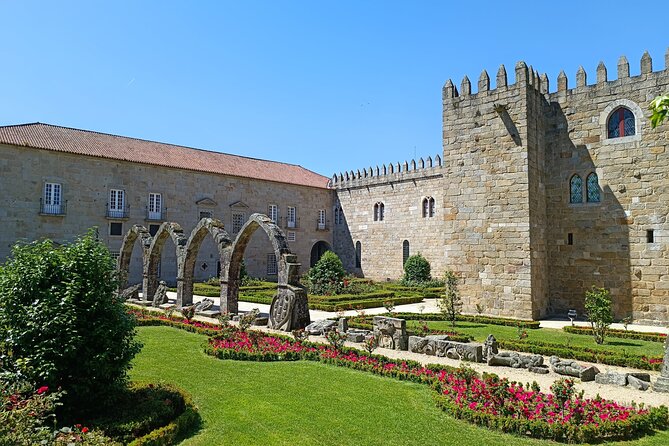
Guimarães Castle is the main historical stop in town. Its square keep and four corner towers make it easy to understand as a defensive building, even though the interior is fairly spare.
The first castle on this hill is linked to Mumadona, a 10th-century countess who ordered a refuge against attacks by Vikings from the north and Muslim forces from the south. Later, Count Henry expanded the defenses into the larger structure associated with the early county of Portucalense.
Tradition also links the building beside the northern wall to Count Henry’s residence and the birthplace of his son, Afonso Henriques. The exact connection is not fully documented, so a good guide should help you separate tradition from confirmed fact.
You have about 30 minutes at the castle, and admission is included. One practical point matters: access is limited, and the castle walls are currently closed to visitors. Do not book this expecting a full walk around the battlements.
The castle may appeal most to people who enjoy political and military history. If you want a furnished royal palace or a large museum, the visit may feel thin. Its value lies in the setting and the story, not in a long list of rooms to explore.
Same base, another direction out:
- Fátima, Nazaré and Óbidos Small-Group Day Trip from Lisbon
★ 4.5 · 3,444 reviews - From Funchal: West Madeira and Laurel Forest Day Trip
★ 4.7 · 2,067 reviews - From Lisbon: Day Trip to Porto, Óbidos, and Nazaré
★ 4.5 · 1,311 reviews - Day Trip from Porto to Santiago de Compostela and Valença
★ 5.0 · 883 reviews
São Miguel do Castelo and the old town
Next comes the small Igreja de São Miguel do Castelo, a Romanesque church built in the 13th century, with local tradition placing its foundation in the 12th century.
According to that tradition, Count Henry built the church and Afonso Henriques was baptized there. The church is plain and compact, with little decoration. Beneath its floor are said to be the graves of warriors from the period when Portugal was being formed.
The scheduled visit is only about ten minutes. That is enough to step inside and hear the story, but not enough for a long quiet visit. Treat it as a brief historical pause between the castle and the old town.
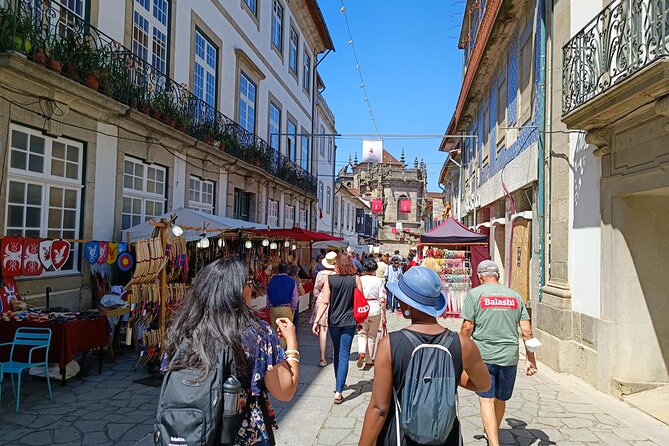
The final stop is Guimarães’ historic center, protected as a UNESCO World Heritage site since 2001. Here the pleasure is in the details: granite balconies, iron verandas, arches over narrow lanes, old paving stones, towers, cloisters, and town houses built over several centuries.
You may pass homes and palaces such as the Mota Prego house, Vila Flor Palace, and Toural Palace. The old center is compact, so the walk gives you a useful first look without requiring a major physical effort.
This is also the best part of the day for simply looking around. I would save some energy for the old town rather than treating every stop as a race to collect photographs.
What the guide adds to the day
The guide matters a great deal on this tour because the places are meaningful in ways that are not always obvious. A staircase is more interesting when you know why its fountains and landings follow a set religious plan. A castle is more memorable when you understand how it relates to Portugal’s first king.
Several guides connected with this tour, including Castro, Philip, Christian, Jose, Pedro, and Jorge, have been singled out for warmth, clear explanations, patience, and strong knowledge of Portuguese history. Of course, the guide assigned to your departure may be different.
The best guides appear to add stories during the drives, not only at the monuments. That makes the minibus time useful rather than dead space. Drivers also matter on a full day, and Carlos, Manuel, and Nuno have received specific praise for smooth, capable service.
There is one clear caution. The tour may combine English and Spanish. The company states that tours are usually conducted in one language, but a second language may be used. If both languages are needed, each explanation takes longer and some people find the commentary harder to follow.
If a single-language tour is important to you, confirm the language arrangement before booking. This is the most consistent practical concern in the feedback, and it can affect how much time you have to explore independently.
Transport, group size, and the $71.35 price
The tour uses a comfortable, air-conditioned minibus with a maximum capacity of 27 people. That is smaller and more personal than a large coach, though it is not an intimate private tour.
The vehicle is especially useful in warm weather and on a nine-hour day. You move between several sites without worrying about regional buses or parking. One person also noted that Wi-Fi was available in the vehicle, although this is not listed as a formal inclusion, so I would not book on that feature alone.
At $71.35 per person, the price is reasonable if you value convenience. It includes transport, a destination-focused guide, Braga Cathedral admission, Guimarães Castle admission, and entrance to Bom Jesus Sanctuary.
Lunch, personal expenses, and hotel pickup are not included. You need to reach the meeting point at Calçada de Vandoma near São Bento Train Station by the 7:50 a.m. start. The activity returns to that same meeting point.
The value is strongest for a first visit to Porto when you want to see both towns in one day. If you are comfortable planning public transport and are happy to pay separate admission fees, an independent visit may give you more time. It will also require more planning and less historical explanation.
Who will enjoy this day trip most
I would recommend this outing to first-time visitors who want a clear introduction to northern Portugal beyond Porto. It suits people who enjoy churches, castles, old streets, national history, and a mix of guided time and personal wandering.
It is also useful for solo visitors. The transport and fixed schedule remove much of the work, while the free periods let you eat or explore without staying beside the group every minute.
Families and older visitors may appreciate the minibus and short walking sections, but the day still includes steps, uneven old paving, and outdoor time. Wear shoes with good grip and bring protection from sun or rain. The tour operates in poor weather, and heavy rain can make the walking portions unpleasant.
I would hesitate if you want a slow, detailed visit to either city. You will see the main sights, but the schedule is designed for coverage. Guimarães, in particular, may leave you wanting a second visit with more time for its streets and buildings.
Should you book the Braga and Guimarães tour?
Book it if you want to see two important northern Portuguese towns without handling the transport yourself. The strongest reasons are the included admissions, the good historical setting, the air-conditioned minibus, and the combination of guided explanation with free time.
Keep your expectations realistic. Bom Jesus is a short visit, the castle has limited access to its walls, and the day can feel long. A bilingual guide may also reduce the amount of English commentary and personal exploring time.
For a first trip to Porto, I think the tour offers solid value at $71.35. If you already know Portugal well, prefer independent travel, or want deep time in one town, spend the day in either Braga or Guimarães instead. You can cancel for a full refund up to 24 hours before departure, subject to the stated terms.
FAQ
Where does the tour start and finish?
The tour starts at Calçada de Vandoma near São Bento Train Station in Porto at 7:50 a.m. It ends back at the same meeting point.
How long does the experience last?
The tour lasts approximately nine hours. The exact timing can change with local traffic, visit schedules, and other operating conditions.
Is lunch included?
No. Lunch is not included, but the itinerary provides free time in Braga for food and independent exploring.
Are entrance fees included?
Yes. The price includes admission to Braga Cathedral, Guimarães Castle, and Bom Jesus Sanctuary.
Can I join if I do not speak Portuguese?
Yes. The tour is offered in English. A second language may also be used, and some departures can be bilingual.
What is the maximum group size?
The maximum capacity is 27 people, traveling by air-conditioned minibus.
New day trips around Portugal
- Lisbon: Arrábida and Sesimbra Day Trip with Wine★ 4.8 · 366 reviews
- Lisbon: Arrábida Natural Park and Sesimbra Day Trip★ 4.9 · 232 reviews
- Algarve: Silves, Lagos, & Cape St. Vicente Day Trip★ 4.1 · 20 reviews
- Lisbon: Sintra Private Day Trip with Pena Palace & Wine Tasting★ 5.0 · 226 reviews
- Private Tour: Sintra and Cascais Day Trip from Lisbon★ 5.0 · 102 reviews
- Private Tour: Sintra, Cabo da Roca and Cascais Day Trip from Lisbon★ 5.0 · 225 reviews
- Sintra EXCLUSIVE Private Day Trip by Car with a Private Guide★ 5.0 · 127 reviews
- Day Trip from Porto to Santiago de Compostela and Valença★ 5.0 · 883 reviews
Day Trips from Porto, compared.

From Porto: Braga and Guimarães Full-Day Trip
Read our review →
Day Trip from Porto to Santiago de Compostela and Valença
Read our review →
From Porto: Arouca 516 and Paiva Walkways Guided Day Trip
Read our review →This day trip also appears in